
Flute Trill Chart
A trill is a rapid alternation between two neighbouring notes, and on the flute some trills are easy — one finger moving — while others would need half the hand to change. This chart puts the standard fingerings for the two notes side by side, highlights exactly what moves, and flags the awkward trills where flutists use trill keys or special trill fingerings.
- Free to use
- No sign-up
- Runs in your browser
Flute trill finder
Flute Trill Practice Pack
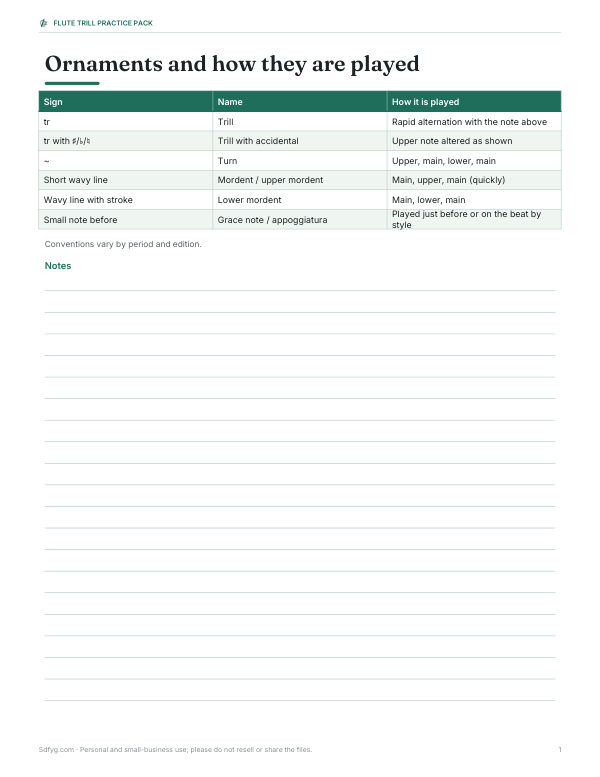
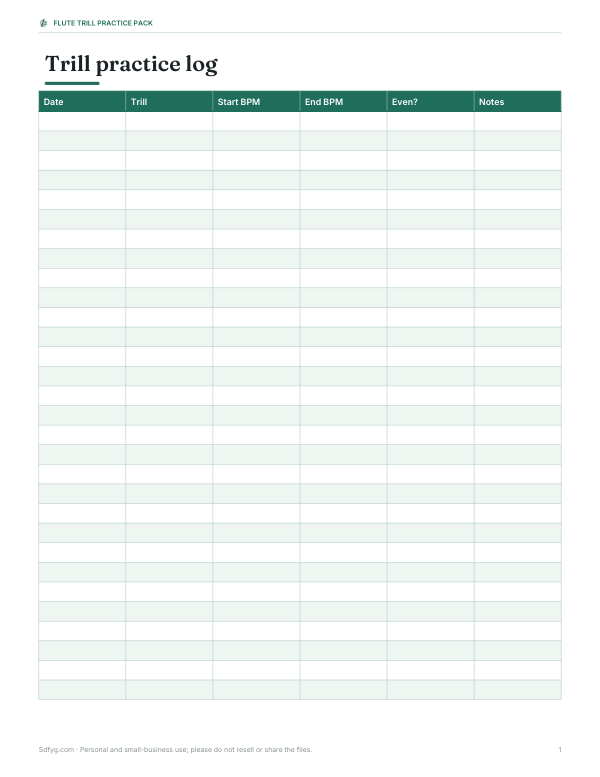
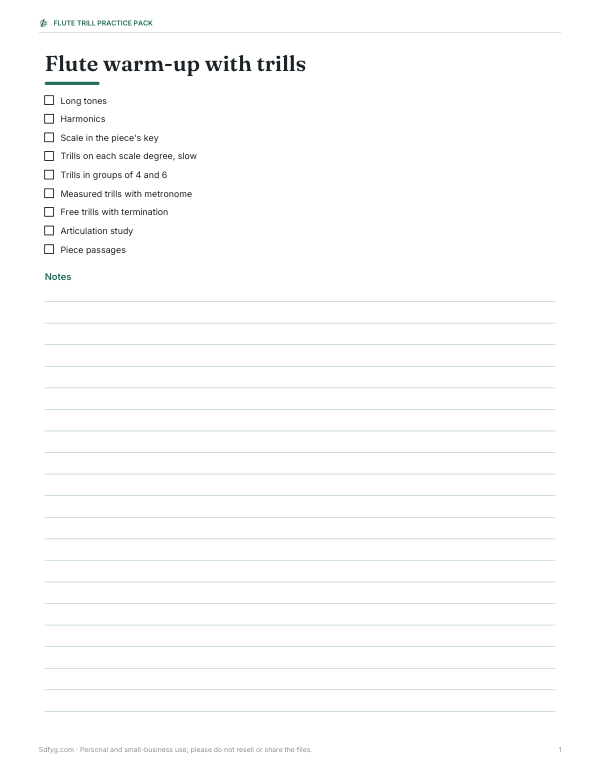
Printable flute trill practice sheets: trill practice log, rhythmic trill exercises, ornament notation reference and a scale and trill warm-up checklist.
- Ornament reference (PDF)
- Practice log (PDF/DOCX/XLSX)
- Warm-up checklist (PDF/DOCX)
- Rhythm exercises (PDF/DOCX)
Formats: PDF, DOCX, XLSX. Instant download after payment (link valid 72 hours, up to 5 downloads). AI-assisted: the templates were drafted with AI help and reviewed and laid out before publishing.
$5.00 USD, one-time 4 files · about $1.25 each
- Instant download
- 7-day refund
- Secure checkout by Stripe
7-day money-back guarantee. Full refund within 7 days of purchase, even after you download.
Free sample: Ornament Notation Reference (PDF, 80 KB)
Full refund within 7 days — see the refund policy and license.
Free printables
Single sheets you can print right now, no sign-up. The full pack adds every sheet in one download plus the editable files.
 Printable Measured Flute Trill Sheet
What a trill is
A trill is a rapid, even alternation between a written note and the note above it — a half step or a whole step, depending on the key signature and any accidental written above the trill sign (tr). In Baroque and Classical music, trills often start on the upper note; in later music they usually start on the main note. Trills commonly end with a turn or termination (two short notes leading to the next note), which may be written out or expected by style.
Why some flute trills are hard
Most trills in the low and middle registers move a single finger: G to A, for example, only lifts the left ring finger. Others change several fingers across both hands — middle C to D involves the left thumb, the left index finger, the left middle and ring fingers and the right hand. Alternating full standard fingerings for these would be slow and uneven, so the Boehm flute has trill keys, and flutists learn special trill fingerings that move one finger while producing a slightly different but acceptable version of one note.
How to read the chart
| Result | What to do |
|---|---|
| Easy | Trill with standard fingerings; aim for evenness and relaxed fingers |
| Manageable | Two fingers move together — practise slowly with a metronome, then speed up |
| Awkward | Look up the special trill fingering for this pair in a dedicated trill chart or method book, or ask a teacher |
This tool is based on the standard fingerings from a standard fingering chart. It doesn’t invent special trill fingerings; it shows why a trill is difficult and whether a special solution is likely to be needed.
Practising trills
- Play the two notes slowly as even eighth notes with a metronome.
- Move to sixteenth notes (four per beat) and increase the tempo a few beats per minute each day.
- Keep fingers close to the keys and move only the fingers that need to change.
- Practise in rhythmic groups — 3s, 4s, 6s — to control the number of notes.
- Finish with a clean termination at the right moment.
- For long trills, keep the airstream steady; don’t let the tone thin out.
The metronome button clicks four times per beat with an accent on the beat, so you can practise measured trills before playing them freely.
Worked example
A student sees a trill on G in the second octave, trilling to A. The chart shows that only the left ring finger moves — an easy trill. Next is a trill on C5 to D5: the chart flags it as awkward, with the thumb, several left-hand fingers and the right hand all changing, and notes that flutists usually finger C and use a trill key instead. The student practises the G–A trill at 80 BPM in sixteenths, then gradually increases the speed to 100.
Trills in different musical styles
| Period | Typical approach |
|---|---|
| Baroque (e.g. Bach, Handel) | Usually start on the upper note, often on the beat; speed may increase through the trill |
| Classical (e.g. Mozart) | Often upper-note start; end with a written or implied turn |
| Romantic and later | Usually main-note start; even speed; termination if marked |
| Contemporary | Follow the composer’s notation — sometimes specifying trill speed or fingering |
Editions and teachers disagree about some details, so listen to recordings of the piece and follow your teacher’s guidance for exams.
Common trill problems
- Uneven trills: one note held longer than the other — practise in dotted rhythms both ways to even them out.
- Tension: fingers lifting too high or pressing too hard — keep them close to the keys.
- Tone thinning: keep the air support steady while fingers move.
- Losing count in measured trills: practise with the metronome clicking subdivisions.
- Late endings: plan exactly where the termination falls in the beat.
Trill keys on the flute
Most flutes have two trill keys, sometimes called the D and D♯ trill keys, played with the right-hand index and middle fingers. They open small tone holes near the top of the body to raise certain notes, which makes several trills in the middle and upper registers possible with one finger movement. Their exact uses are covered in trill charts in flute method books and reference fingering guides; your teacher can show which you need for your music.
Privacy
The trill finder runs in your browser.
Frequently asked questions
What is a flute trill?
A rapid alternation between two neighbouring notes, marked tr.
Does a trill start on the upper or main note?
Often the upper note in Baroque and Classical music, and the main note in later music.
What are flute trill keys?
Two small keys played by the right hand that make some middle and upper trills easier.
How do I play the C–D trill on flute?
Many flutists finger C and trill with a trill key; check the trill chart in your method book or ask your teacher.
How can I make my trills faster?
Practise slowly and evenly with a metronome, then increase the tempo gradually.
Is this a complete trill chart?
It shows standard fingerings and what changes; use a dedicated trill chart for special fingerings.
What is a whole-step and half-step trill?
A half-step trill alternates notes a semitone apart; a whole-step trill notes a tone apart, set by the key signature or an accidental above the trill.
How fast should a trill be?
Fast enough to sound like a shimmer, but always even — control matters more than speed.
Do I need a trill key for every trill?
No — most trills use standard fingerings; only certain awkward pairs need trill keys or special fingerings.